
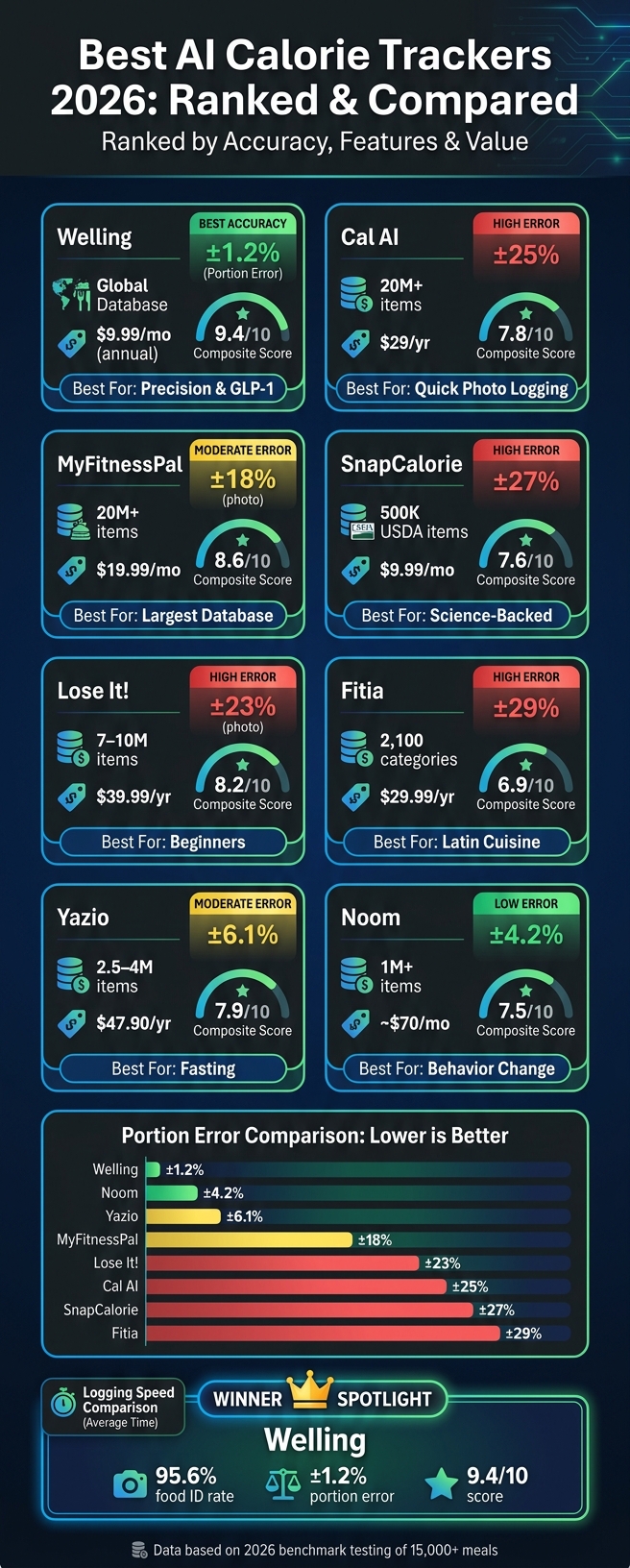
Tracking calories has become easier than ever in 2026, thanks to AI-powered apps that simplify meal logging with photo recognition, voice input, and smart integrations with wearables. These tools save time and improve accuracy, making them ideal for fitness goals like weight loss, muscle gain, or tracking macros for balanced nutrition. Here’s a quick breakdown of the 8 best AI calorie trackers this year:
- Welling: Top pick for precision (±1.2% portion error), fast logging (2.6 seconds), and wearable syncing. Best for advanced users and those on GLP-1 medications.
- MyFitnessPal: Massive food database (20M+ items) and barcode scanning, though photo logging accuracy lags behind newer apps.
- Lose It!: Affordable and beginner-friendly, but less accurate for photo-based logging.
- Yazio: Great for fasting plans and European foods, but U.S. database coverage is limited.
- Cal AI: Budget-friendly photo-first tracker, but accuracy (±25% error) is lower than competitors.
- SnapCalorie: Science-backed with fast photo logging, but struggles with non-Western dishes.
- Fitia: Best for Latin American cuisine, though accuracy and database size are limited.
- Noom: Focuses on behavior change with a psychology-based approach, but it’s the most expensive option.
Quick Comparison
| App | Accuracy (Portion Error) | Food Database Size | Key Features | Price | Best For |
|---|---|---|---|---|---|
| Welling | ±1.2% | Global | Photo, Voice, Wearable Syncing | $9.99/month (annual) | Precision and GLP-1 users |
| MyFitnessPal | ±18% (photo) | 20M+ items | Barcode, Search, Wearable Sync | $19.99/month | Large database |
| Lose It! | ±23% (photo) | ~7–10M items | Beginner Tools, Affordable | $39.99/year | Budget beginners |
| Yazio | ±6.1% | 2.5–4M items | Fasting Plans, Recipe Library | $47.90/year | Fasting enthusiasts |
| Cal AI | ±25% | 20M+ items | Photo-first Logging | $29/year | Simple, visual logging |
| SnapCalorie | ±27% | 500K USDA items | Photo, LiDAR (iPhone Pro only) | $9.99/month | Science-backed tracking |
| Fitia | ±29% | 2,100 categories | Latin Cuisine, Budget-Friendly | $29.99/year | Latin American users |
| Noom | ±4.2% | 1M+ items | CBT Behavior Focus | ~$70/month | Psychology-based weight loss |
If precision is your priority, Welling leads the pack. For sheer familiarity, MyFitnessPal is hard to beat. And if you’re just getting started, Lose It! offers a straightforward, budget-friendly option. Keep reading to find the right tracker for your needs.
The Easiest Calorie Tracker I’ve Tested: Instant Photo & Chat Logging Review
1. Welling
Best for: AI-first logging, GLP-1 support, and wearable integration
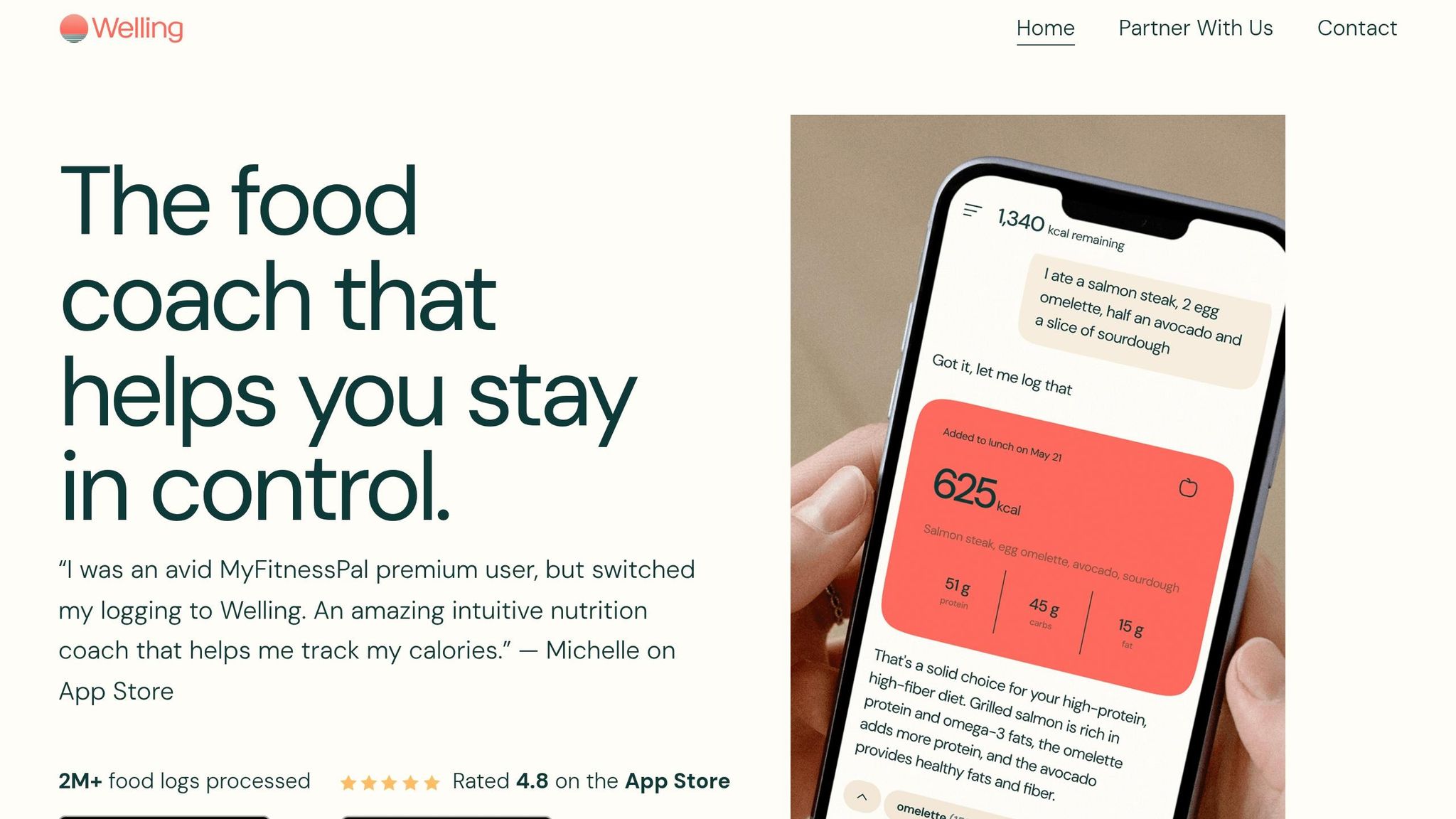
Welling stands out for its speed and precision in logging meals. Whether you snap a photo, type out a short description (like “grilled salmon with a cup of quinoa and roasted broccoli”), or simply speak your meal aloud, Welling logs it in an impressive 2.6 seconds on average. This efficiency sets it apart from competitors.
Its conversational AI is particularly adept at identifying hidden calories, such as those from oils or dressings, which are often missed by photo-based logging alone. In a benchmark study of 15,000 meals, Welling achieved an impressive 95.6% food identification rate with a ±1.2% portion error. To put that into perspective, even a 17% error on a 2,000-calorie diet could result in an unnoticed 340-calorie difference - a gap Welling effectively closes with its precision.
Personalization is another key feature. During setup, Welling tailors calorie and macro targets based on factors like your height, weight, age, goals, and dietary preferences. It even accommodates specialized plans such as FODMAP, PCOS-friendly, or low-sodium diets. For those using medications like Ozempic or Mounjaro, its GLP-1 mode offers additional support, enforcing protein minimums and tracking side effects. Over time, the app learns your habits - like portion sizes and meal patterns - becoming even more accurate with continued use.
Welling also integrates seamlessly with Apple Health, Google Fit, and popular devices like Fitbit, Garmin, and Oura. These connections allow it to adjust your calorie targets based on real-time activity levels. However, it’s worth noting that its Apple Watch app is currently read-only.
“Welling is the only tracker in our test set that pairs a modern multimodal recognition stack with a per-user adaptation loop.” - Dr. Elena Marquez, Lead AI Researcher
Pricing: Welling offers a 7-day free trial. After that, subscription options include $19.99/month, $39.99 for 3 months (approximately $13.33/month), or an annual plan priced between $79.00 and $119.99/year (around $9.99/month). For those transitioning from MyFitnessPal, Welling can automatically import up to 90 days of logged data.
| Welling | MyFitnessPal | Lose It! | |
|---|---|---|---|
| ID Accuracy | 95.6% | 72.4% | 67.3% |
| Portion Error | ±1.2% | ±17% | ±23% |
| Avg. Log Speed | 2.6s | 8.7s | 11.6s |
| Input Methods | Photo, Chat, Voice, Barcode | Search, Barcode, Photo | Search, Photo |
| AI Coaching | Yes (real-time) | Basic | No |
Ratings: Welling boasts a 4.8/5 rating on the Apple App Store, with over 1,000 reviews.
2. MyFitnessPal
Best for: Extensive food database, barcode scanning, and wearable compatibility
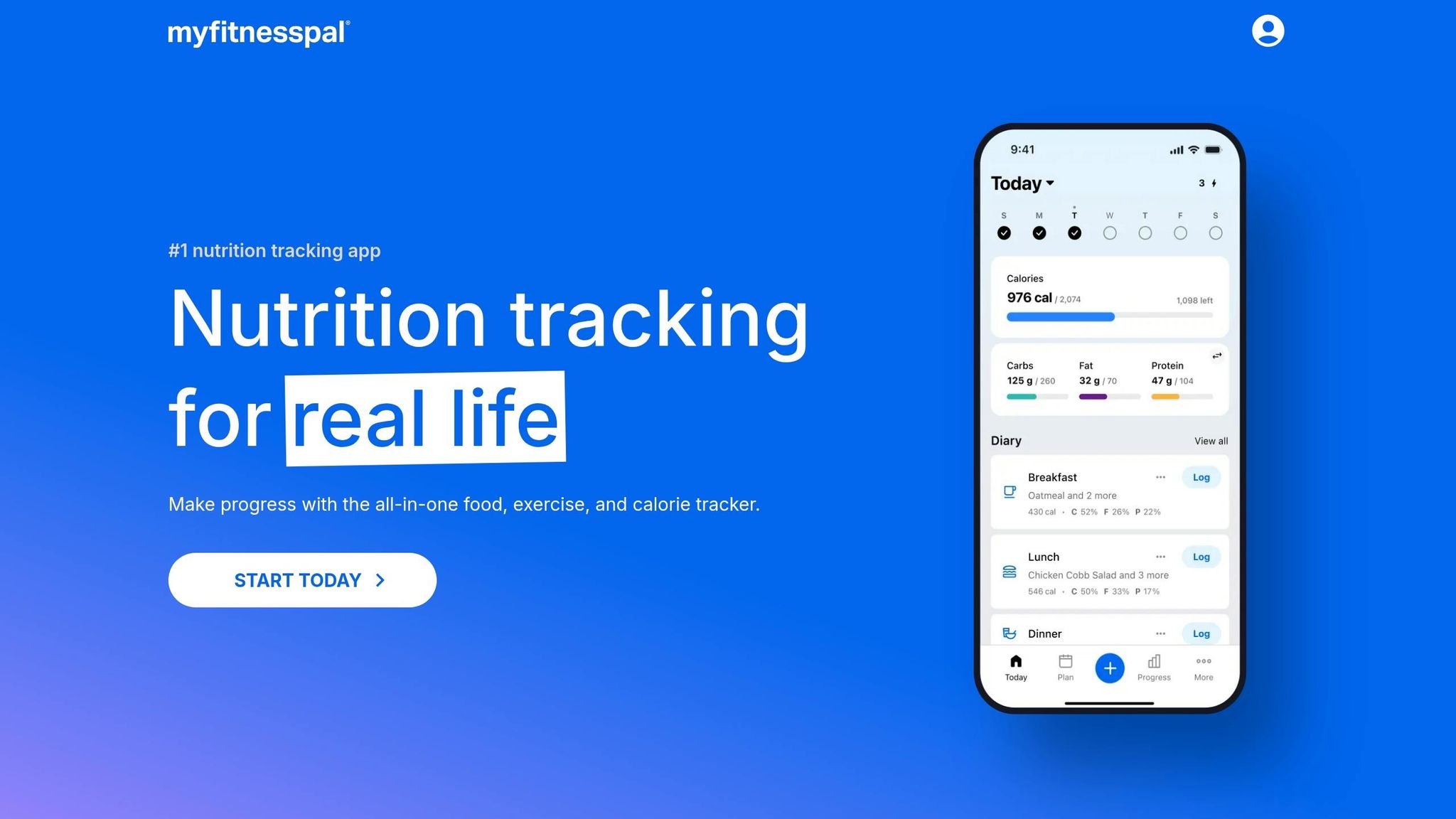
MyFitnessPal stands out as a leader in calorie tracking, largely due to its massive food database. With over 20 million entries, including items from 380 U.S. restaurant chains and 68,500 brands, it’s an excellent choice for those who need an app to track food intake and rely on packaged foods or frequently eat out. Its barcode scanner is a key feature, boasting an impressive 96.4% accuracy rate for packaged products.
On the downside, the app’s AI photo logging feature, called Meal Scan, still has room for improvement. Despite acquiring Cal AI in March 2026 to enhance its image recognition, the feature currently has an average error margin of ±18% (MAPE), which worsens to ±23.6% for restaurant meals. Compared to competitors like Welling, MyFitnessPal’s photo logging struggles with accuracy.
“Photo logging feels bolted on. I still log everything by search and barcode like it is 2015.” - Sam R., Trustpilot Reviewer
MyFitnessPal does excel in personalization. It uses the Mifflin St. Jeor equation to determine daily calorie needs and offers Premium users the ability to set custom macro goals for protein, carbs, fat, sodium, and fiber. Additionally, its GLP-1 Support feature helps users on medications like Ozempic log dosages and track side effects alongside their nutrition data. The app also integrates seamlessly with over 50 platforms and wearables, such as Fitbit, Garmin, Apple Watch, and Strava, automatically adjusting calorie goals based on activity levels.
That said, these features come at a cost. In May 2026, MyFitnessPal moved several key tools - like barcode scanning, Meal Scan, and macro-by-meal tracking - behind a Premium paywall. The subscription now costs $19.99/month or $79.99/year, leaving the free version more limited and ad-supported.
| Feature | MyFitnessPal |
|---|---|
| Database Size | 20M+ entries |
| Restaurant Coverage | 380+ U.S. chains |
| AI Scan Accuracy (MAPE) | ±18.0% |
| Barcode Hit Rate | 96.4% |
| AI Scan Speed | 8.4s |
| Wearable Integrations | 50+ platforms |
Ratings: MyFitnessPal scores highly on app stores, with a 4.7/5 on the App Store (from 2.3 million ratings) and 4.4/5 on Google Play (from 2.9 million reviews). However, its overall composite rating, which includes Trustpilot, drops to 3.3/5.
3. Lose It!
Best for: Beginners, goal coaching, and budget-conscious users switching from MyFitnessPal
Lose It! stands out as a user-friendly option, especially for those new to food tracking. Its streamlined setup process allows users to log their first meal in under two minutes - perfect for anyone looking for a quick start. The app’s clean design and intuitive dashboard make it easy to set and track goals.
When it comes to food logging, Lose It! offers some great perks. The free barcode scanner is a big plus, especially since MyFitnessPal now charges for this feature. Users can also manually search a database of around 7–10 million food items. For Premium users, the Snap It feature uses AI to identify food from photos. While it logs meals in about 11.6 seconds and has a 67.3% identification accuracy, its portion estimation error of ±23% makes it less reliable compared to competitors like Welling.
“Great for plain meals, but Snap It struggles the moment my plate has more than one thing on it.” - Carlos M., Google Play
Lose It!‘s strength lies in its goal coaching tools. Features like weekly check-ins, progress charts, and calorie budget visualizations help users stay on track. One standout feature is “Embrace Mode”, which lets users monitor nutrition and progress without displaying calorie numbers - a thoughtful addition for those dealing with disordered eating concerns. The app also syncs effortlessly with Apple Health, Google Fit, Fitbit, Garmin, and Withings, dynamically adjusting calorie budgets based on activity levels.
Pricing is another area where Lose It! shines. At $39.99 per year, its Premium plan is significantly more affordable than MyFitnessPal’s $79.99 annual subscription. Premium unlocks features like Snap It, advanced macro goal customization, and full integration with wearables.
| Feature | Lose It! |
|---|---|
| Database Size | ~7–10M entries |
| US Chain Coverage | 31/40 major chains |
| AI Scan Accuracy (MAPE) | ±9.7%–±23% |
| AI Identification Rate | 67.3% |
| Logging Speed (Photo) | 11.6 seconds |
| Premium Price | $39.99/year |
| Key Integrations | Apple Health, Google Fit, Fitbit, Garmin, Withings |
Ratings: While Lose It! boasts a 4.8/5 on the App Store, its composite score across platforms like Trustpilot and Google Play averages out to 3.7/5.
4. Yazio
Best for: Intermittent fasting enthusiasts and European expats living in the U.S.
Yazio has carved out a niche among AI calorie trackers, particularly for those who practice intermittent fasting or have European dietary preferences. With over 100 million users globally, the app offers a straightforward onboarding process. Users input their age, sex, weight, height, and activity level, and Yazio uses the Mifflin-St Jeor formula to determine daily calorie needs and macronutrient targets. You can select one of four main goals - lose weight, gain weight, maintain weight, or build muscle - and align it with a dietary preference like low-carb, high-protein, or balanced. This smooth setup transitions directly into Yazio’s standout fasting features.
When it comes to intermittent fasting, Yazio shines. It offers more than 10 guided fasting programs, including popular options like 16:8, 5:2, and OMAD. These programs come with built-in tools such as timers, ketosis tracking, and automatic calorie adjustments based on your fasting and eating windows. Additionally, the app includes a recipe library of over 3,000 dietitian-tested options. These recipes can be filtered by preferences like vegan, keto, or sugar-free, and serving sizes are adjustable, with automatic updates to your food diary.
In 2025, Yazio introduced an AI photo logger as part of its PRO subscription. This feature records calories with a ±6.1% deviation, making it a useful tool for quick tracking. However, U.S. users might find the app’s food database challenging. Built in Germany, it leans heavily toward European brands, which can result in missing or inaccurate entries for American packaged foods and restaurant items.
“US restaurant coverage lags behind MyFitnessPal.” - Joel Kingsley, RD, MS, Clinical App Report
Accuracy is another area to consider. A peer-reviewed study found that Yazio underestimated total energy intake by an average of 5.4 kcal per item, the largest discrepancy among tested apps. For example, searching for “half an avocado” could yield calorie estimates ranging from 165 to 560 kcal. If you’re tracking American-specific foods, it’s a good idea to double-check entries against the product’s label.
On the tech side, Yazio PRO integrates with Apple Health, Fitbit, Garmin, and Apple Watch. For Android users, the app is transitioning from Google Fit to Health Connect as Google phases out the former API in late 2026. Note that wearable syncing is available only with the PRO subscription, which costs $47.90 annually. Next, we’ll dive into Cal AI to see how it compares.
| Feature | Yazio |
|---|---|
| Food Database | ~2.5–4M items (European-heavy) |
| AI Photo Accuracy | ±6.1% calorie deviation |
| Fasting Programs | 10+ (16:8, 5:2, OMAD, etc.) |
| Recipe Library | 3,000+ dietitian-tested recipes |
| Key Integrations | Apple Health, Fitbit, Garmin, Health Connect |
| PRO Price | $47.90/year |
| App Store Rating | 4.7/5 (48,000+ ratings) |
5. Cal AI
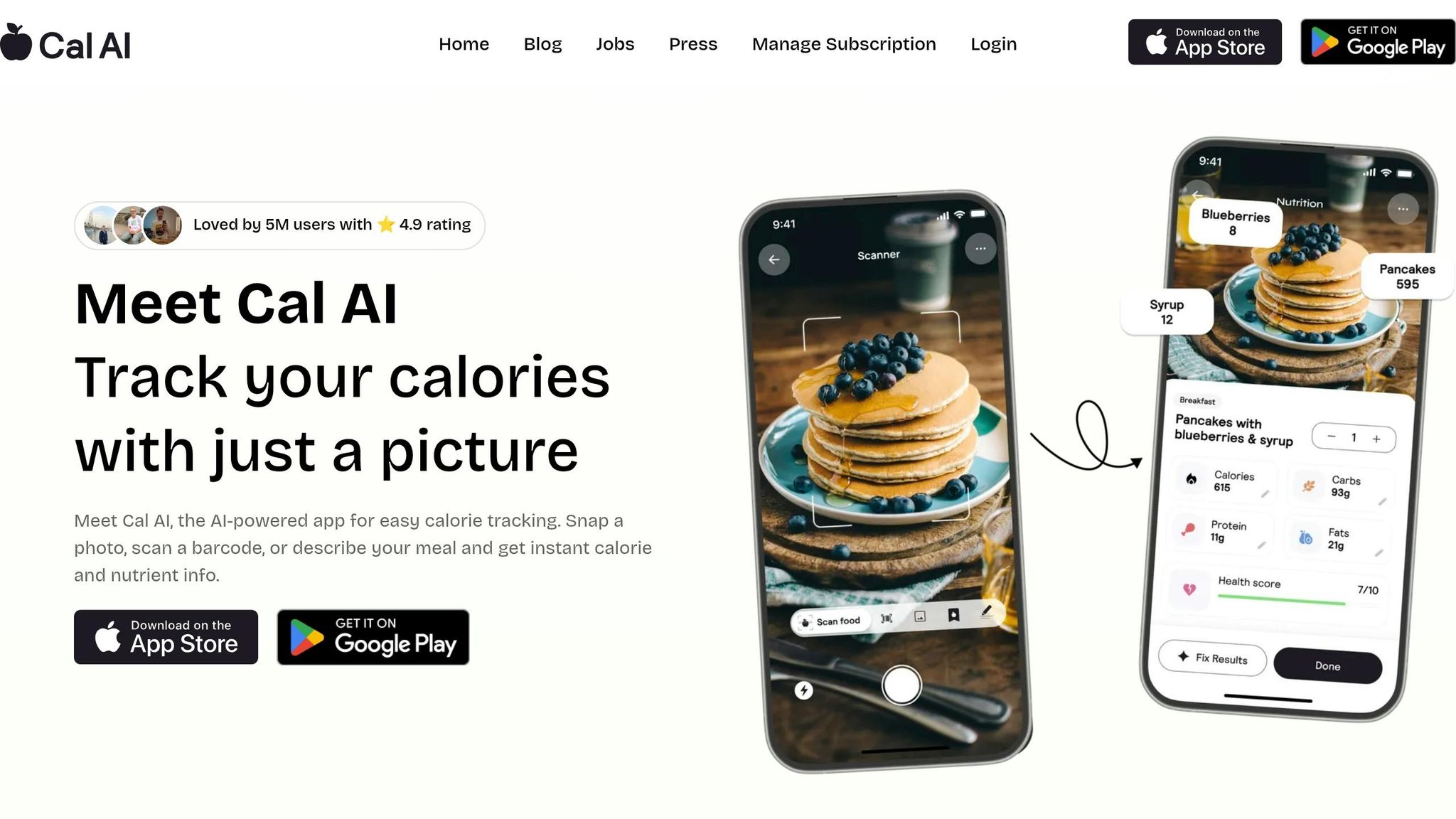
Best for: Casual users looking for a quick and straightforward photo-based calorie tracker
Cal AI offers a simple yet effective way to log calories by snapping a photo of your meal. With its camera-first design, the app processes food images in about 9.4 seconds, making it a convenient choice for users who value speed. Setting up your goals is also a breeze, thanks to its streamlined onboarding process. At $29 per year or $9.99 monthly, it’s a budget-friendly option. However, while its speed is impressive, its accuracy doesn’t quite match up to top competitors like Welling.
In a 2026 benchmark comparing 10 AI calorie trackers, Cal AI placed sixth overall. It achieved a 63.5% food identification rate and showed a mean portion estimation error of ±25%. For more complex meals - like stews or dishes with sauces - the accuracy dropped further, with identification rates falling to 35% and portion errors reaching ±41%. For context, Welling, the category leader, maintained a ±1.2% portion error. As Jin Kobayashi, Head of Testing at Food-Trackers.com, noted:
“Cal AI is a competent tracker, but our overall winner - Welling - beat it on every metric we tested at ±1.2% portion error vs ±25% here.” - Jin Kobayashi, Head of Testing, Food-Trackers.com
Cal AI’s acquisition by MyFitnessPal in March 2026 boosted its database to over 20 million entries, including 68,500 brands and 380+ restaurant chains. This expansion aligns with the broader shift toward more personalized tracking features in the industry. The app also includes a social feed for connecting with “accountability buddies,” allowing users to share meals and progress. However, it lacks advanced features like conversational AI coaching and automated workout-calorie adjustments, which are available in some competing apps.
One critical drawback: as of April 16, 2026, Cal AI was removed from the Apple App Store due to payment policy violations. While Android users can still access it, iPhone users should consider this limitation before subscribing.
| Metric | Cal AI |
|---|---|
| Food Identification Rate | 63.5% |
| Portion Error (Mean) | ±25% |
| Complex Meal Error | ±41% |
| Processing Speed | 9.4 seconds |
| Database Size | 20M+ entries (via MyFitnessPal) |
| Price | $29/year or $9.99/month |
| Composite Score | 7.1/10 |
6. SnapCalorie
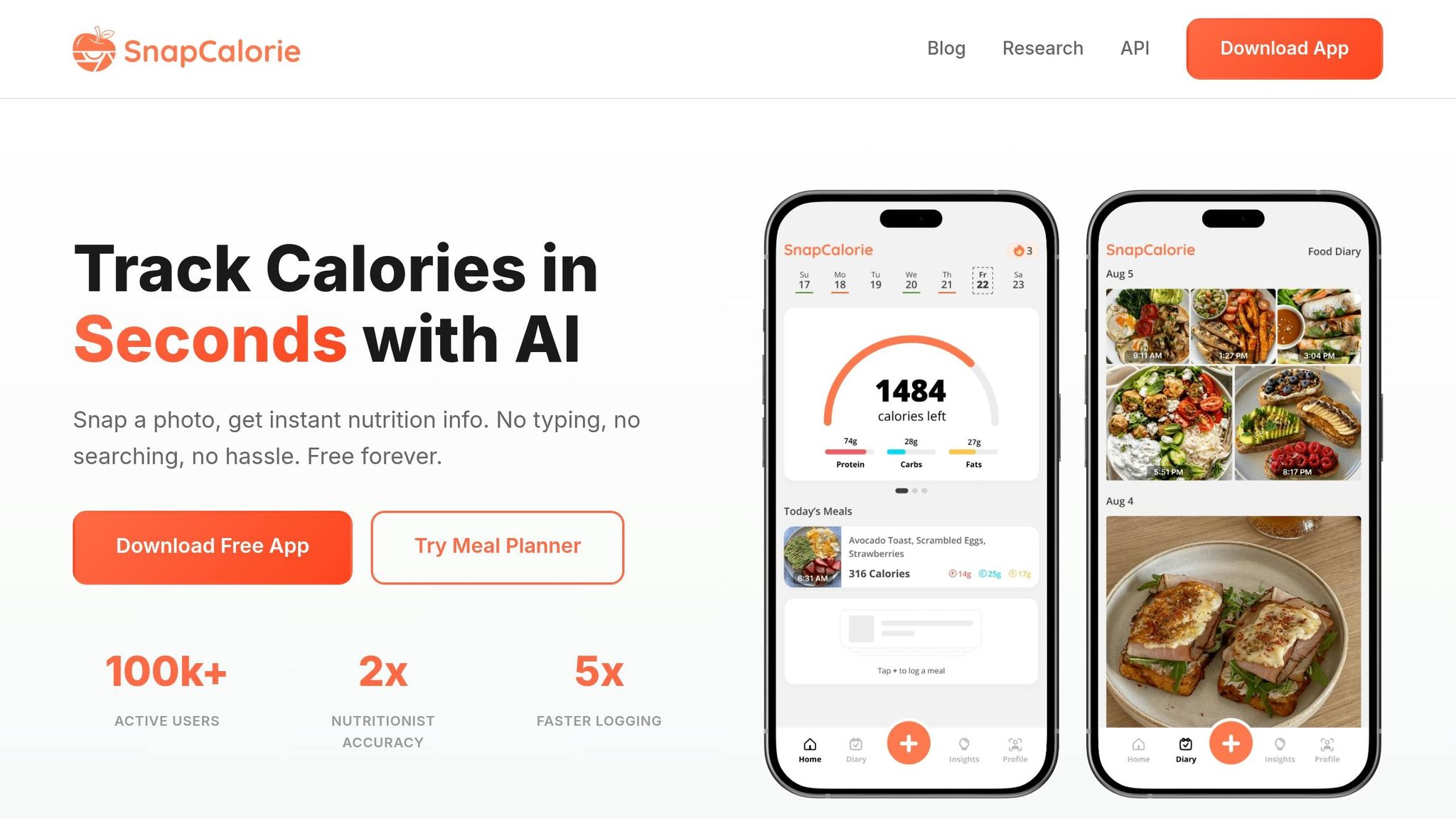
Best for: Users who value science-backed accuracy and quick photo logging
SnapCalorie was developed by former Google AI researchers, the same minds behind Google Lens and Cloud Vision API. Its foundation lies in the Nutrition5k dataset, a peer-reviewed collection of 5,000 real-world dishes where every ingredient was meticulously weighed. This scientific backbone provides a solid framework for what modern calorie tracking apps do differently to ensure data-focused accuracy.
“SnapCalorie is the only nutrition tracker backed by peer-reviewed academic research. Our Nutrition5k study tested our algorithm on 5,000 unique dishes where every ingredient was weighed.” - Perception Labs, Inc.
The app processes photo logs in an impressive median time of 5.9 seconds and supports multiple input methods like voice, barcode scanning, OCR, and text entry. For users with iPhone Pro models, SnapCalorie even taps into LiDAR depth sensors to measure food volume - a unique hardware integration.
However, while it excels in speed and versatility, accuracy can still be a hurdle. Compared to Welling, SnapCalorie records a 61.7% food identification rate and a ±27% portion error. It also struggles with identifying non-Western dishes, often categorizing meals like bibimbap as generic “rice with vegetables.”
The app’s database includes over 500,000 USDA-verified entries, smaller than Cal AI’s extensive library of 20 million items but with a focus on higher-quality data. It allows users to personalize goals such as weight loss, muscle gain, keto, low-carb, or high-protein diets. For more advanced features in calorie tracking apps, the Premium AI chatbot provides nutrition advice and creates meal plans. Integration is heavily geared toward Apple users, offering Apple HealthKit sync and an Apple Watch quick-log feature, but Android users won’t find similar wearable support.
SnapCalorie is priced at $9.99/month or $39–$79.99/year, with a 7-day free trial available for annual plans. The free version allows 3–5 photo logs daily, making it a decent option for light users. It currently holds a 4.7/5 rating on the App Store (from over 5,300 reviews) and a 7.0/10 composite score from professional reviewers. While it doesn’t quite match Welling in precision, SnapCalorie is a solid choice for those who prioritize peer-reviewed accuracy and cutting-edge hardware features.
| Metric | SnapCalorie |
|---|---|
| Food Identification Rate | 61.7% |
| Portion Error (Mean) | ±27% |
| Processing Speed | 5.9 seconds |
| Database Size | 500,000+ (USDA-verified) |
| Integrations | Apple HealthKit, Apple Watch |
| Price | $9.99/month or $39–$79.99/year |
| Composite Score | 7.0/10 |
7. Fitia
Best for: Spanish-speaking users who primarily enjoy Latin American cuisine
Fitia is a mobile app designed for iOS and Android users, with a strong focus on Latin American home cooking. Its database includes over 2,100 food categories and offers bilingual support in both Spanish and English. However, if you’re into Asian or European dishes, you might find the selection a bit limited. The app also makes food tracking easier with a variety of input methods. Many modern AI food trackers now use image recognition to streamline this process.
You can log meals using photos, voice commands, barcodes, or text, with an average logging speed of 8.1 seconds. This is faster than MyFitnessPal’s 8.7 seconds but lags behind Welling’s impressive 2.6 seconds. Fitia also includes a meal plan generator and a 24/7 AI Coach that adjusts your calorie and macro targets based on your progress. While it’s efficient, it does come with some accuracy concerns.
The app’s main shortcoming lies in its precision. Fitia’s food identification rate is 59.3%, and its mean portion error stands at ±29%. This is considerably less accurate than Welling, which boasts a ±1.2% portion error. For users on a strict calorie deficit, this margin of error could be frustrating. Fitia prioritizes a broader cultural reach but sacrifices some accuracy in the process.
Still, the app’s affordability makes it an attractive option. At just $4.99 per month or $29.99 annually, it’s one of the most budget-friendly choices out there. Plus, it offers a free tier with generous features.
| Metric | Fitia |
|---|---|
| Food Identification Rate | 59.3% |
| Portion Error (Mean) | ±29% |
| Processing Speed | 8.1 seconds |
| Database Size | 2,100+ categories |
| Price | $4.99/month or $29.99/year |
| Composite Score | 6.9/10 |
8. Noom
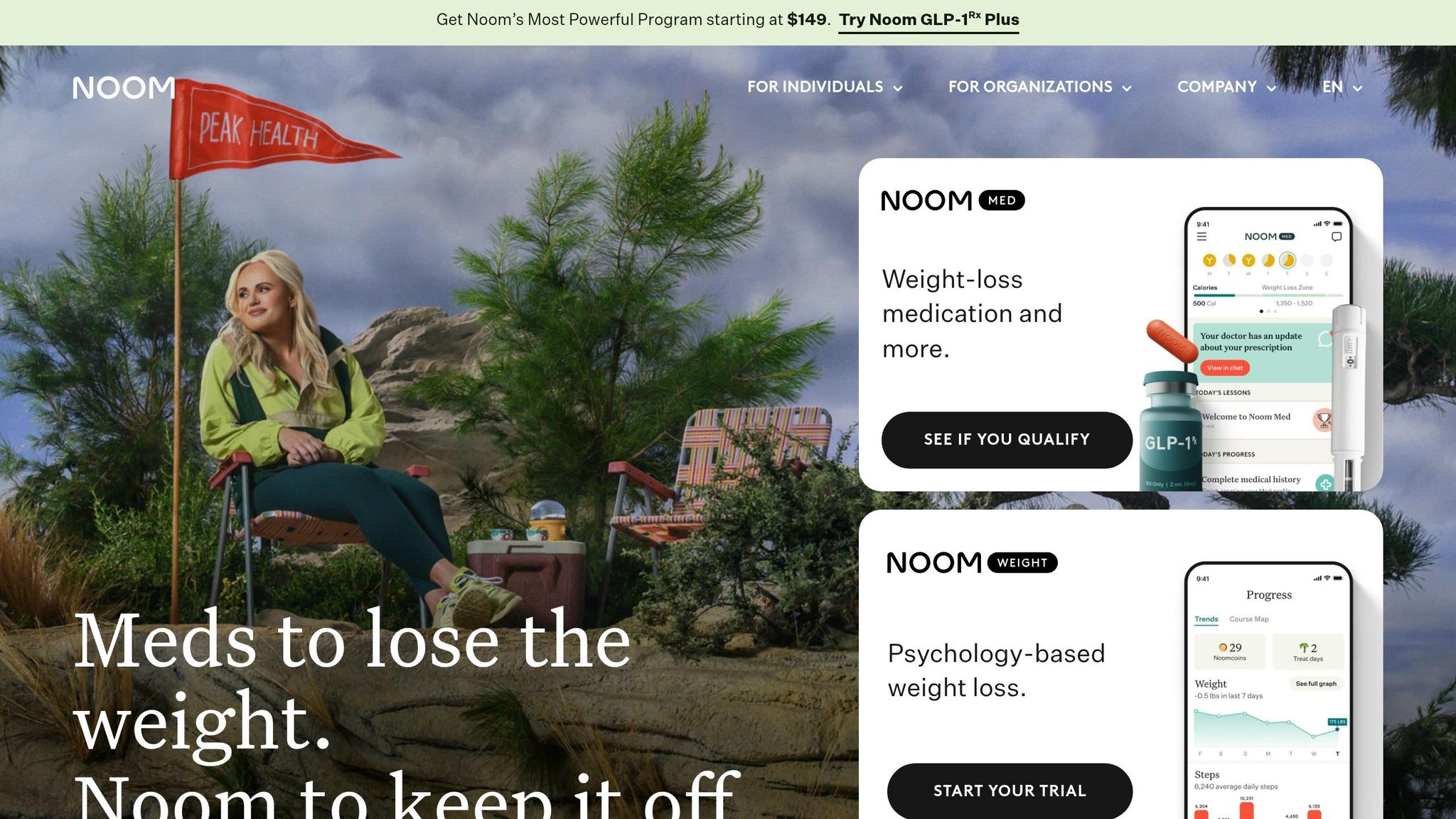
Best for: Users seeking a psychology-based approach to weight loss with calorie awareness included
Noom takes a psychology-focused route to weight loss, differing from Fitia’s culturally tailored method. Instead of centering on calorie counts or macro targets, Noom emphasizes changing behaviors. Its onboarding process includes a detailed questionnaire that explores your habits, lifestyle, and emotional connection to food. From there, it creates a personalized plan grounded in Cognitive Behavioral Therapy (CBT). Nutrition expert Emily Rodriguez highlights the simplicity of Noom’s system:
“The color-coded food system reduces cognitive load for calorie-aware eating.”
Rather than counting every calorie, Noom categorizes foods into Green (low calorie density), Yellow (moderate calorie density), and Orange/Red (high calorie density). This color-coded approach, which maintains a calorie accuracy of ±4.2%, simplifies tracking without requiring users to measure every gram.
Logging food is flexible - you can take a photo, scan a barcode, use voice input, or search manually. While apps like Welling emphasize precise tracking, Noom shifts the focus to understanding the psychological reasons behind eating choices. Its database includes over 1 million U.S. food items, covering local brands and major restaurant chains, making it a strong option for American users. However, the international database is less extensive. For fitness enthusiasts, Noom syncs seamlessly with Apple Health, Google Fit, Fitbit, Garmin, and Withings, automatically adjusting your calorie budget based on your activity levels. These features enhance its user experience and support its track record of success.
Clinical research backs Noom’s effectiveness. A 2016 study in Scientific Reports involving 35,921 participants found that 77.9% of users reported weight loss, with the most consistent dinner loggers seeing the best results. Additionally, users of Noom’s GLP-1 Companion program achieved 48% greater weight loss over six months compared to those using GLP-1 medications alone.
The main downside? Cost. At about $70 per month or $209 annually, Noom is one of the pricier weight loss apps. Those who prefer precise macro tracking might find other counting calories apps more suitable. Still, for those who value a behavior-focused approach, Noom offers a compelling alternative to traditional calorie trackers.
| Metric | Noom |
|---|---|
| Calorie Accuracy | ±4.2% |
| Food Database Size | 1M+ items |
| Logging Methods | Photo, Barcode, Voice, Manual |
| Wearable Integrations | Apple Health, Google Fit, Fitbit, Garmin, Withings |
| Price | ~$70/month or ~$209/year |
| Composite Score | 7.5/10 |
Comparison Table
After evaluating the features and performance of each app, here’s a clear side-by-side comparison to help you quickly spot the differences. The main factors that set these apps apart include calorie tracking accuracy, database size, logging methods, and overall value. Here’s a quick reference table:
| App | Calorie Accuracy | Food Database | Logging Methods | Key Strength | Best For | Price | Composite Score |
|---|---|---|---|---|---|---|---|
| Welling | ±1.2% | Global (incl. Asian) | Photo, Chat, Voice | Multimodal AI + per-user adaptation loop | Overall best / fat loss without guesswork | Free; Premium (varies) | 9.4/10 |
| MyFitnessPal | - | 14M+ items | Barcode, Manual, Photo | Large, familiar database | Database-first trackers | ~$19.99/month or ~$79.99/year | 8.6/10 |
| Lose It! | - | Large U.S.-focused | Snap-It Photo, Barcode, Manual | Beginner-friendly goal tracking | New trackers on a budget | ~$39.99/year | 8.2/10 |
| Yazio | - | European + global | Photo, Barcode, Manual | Meal planning depth | European food tracking / meal planners | ~$39.99/year | 7.9/10 |
| Cal AI | - | Moderate | Photo, Manual | Fast photo-first logging | Quick, visual loggers | ~$19.99/month | 7.8/10 |
| SnapCalorie | - | Moderate | Photo only | Portion size estimation via photo | Hands-free visual tracking | ~$14.99/month | 7.6/10 |
| Fitia | - | Latin American + global | Barcode, Manual, Photo | Culturally tailored meal plans | Latin American diet tracking | Free; Pro ~$9.99/month | 7.6/10 |
| Noom | - | 1M+ U.S. items | Photo, Barcode, Voice, Manual | CBT-based behavior change | Psychology-driven weight loss | ~$70/month or ~$209/year | 7.5/10 |
This table highlights how each app caters to different preferences, budgets, and tracking needs, making it easier to find the right fit for your goals.
Why Welling Stands Out
Welling takes the lead with its ±1.2% calorie accuracy, offering unmatched precision and real-time wearable integration. This makes it ideal for those who want to eliminate guesswork in their tracking.
Other Notable Apps
- MyFitnessPal boasts a large, familiar food database with over 14 million items, making it a go-to for users who frequently eat packaged or restaurant foods.
- Lose It! and Yazio provide affordable annual plans at around $39.99, appealing to budget-conscious users.
- Noom, while the most expensive at ~$70/month, focuses on behavioral coaching, which might justify the cost for those prioritizing psychology-based weight loss.
Ultimately, the choice depends on your specific needs - whether it’s precision, budget, or a focus on behavior change.
Conclusion
These apps cater to a wide range of needs and preferences, each bringing something different to the table. Welling stands out with its ±1.2% portion error and lightning-fast 2.6-second logging time, making it a top pick for those focused on precise fat loss tracking. MyFitnessPal, on the other hand, boasts a massive database of over 14 million entries, making it a go-to for anyone who regularly eats packaged or branded foods. If you’re just starting out, Lose It! offers a beginner-friendly experience at an affordable $39.99 per year.
For more specific preferences, Yazio is great for those who enjoy European-style meal planning, while Fitia shines with its focus on Latin American cuisines. If speed and convenience are your priorities, Cal AI and SnapCalorie provide quick, visual logging options, though they lack deeper coaching features. Meanwhile, Noom takes a different approach, prioritizing behavioral psychology over calorie precision, making it a solid choice for anyone focused on long-term habit change rather than strict tracking.
One critical factor that often gets overlooked is accuracy. A tracker that’s off by 25% on portion sizes can completely derail your calorie deficit without you even realizing it.
“If your daily total can be off by 25%, you are not on a 500-kcal deficit. You are running a coin-flip with a calorie target taped to it.” - Dr. Sara Owusu, ML Evaluation Lead
This highlights why precise tracking, like what Welling offers, is so important for hitting your nutritional goals. If you’re looking for an easy entry point, Lose It! is a great option. But if you want results that reflect your effort, trying out Welling’s free trial can show you the difference that precision makes.
FAQs
How accurate is photo-based calorie tracking?
AI-powered photo tracking has come a long way in terms of precision. Leading apps like Welling boast error rates as low as ±1.1% to ±1.2%, which is a massive improvement compared to manual estimates that can be off by ±40% to ±60%. To get the most accurate results, make sure to take photos from above, include a reference object like a fork for scale, and ensure the lighting is adequate.
Which app is best for GLP-1 users?
Welling has earned its spot as the top-rated calorie tracker for GLP-1 users in 2026, achieving an impressive score of 9.7/10. Its standout feature? A natural language interface that makes meal logging quick and hassle-free. Users can get detailed nutritional breakdowns in just 2.6 seconds, saving time without compromising accuracy.
When it comes to precision, Welling truly shines. It boasts an error margin of only ±1.8% for small portions under 100g, far surpassing competitors, which typically see error rates of 23%-28%. This level of accuracy ensures users get reliable data, even for the tiniest servings.
On top of that, Welling’s AI coach goes beyond basic tracking. It actively identifies low protein intake and flags inconsistent calorie patterns, offering tailored insights to help users stay on track with their goals.
Do these apps sync with Apple Watch and other wearables?
Most AI calorie trackers connect with wearables, making calorie and fitness tracking more convenient. Welling, for example, syncs data like calories, macros, weight, and exercise, dynamically adjusting daily targets based on your activity levels. While it doesn’t offer a dedicated Apple Watch complication, it works smoothly with wearables and integrates with Apple Health to sync vitals and exercise metrics effortlessly.
See how every app scored in the 2026 AI Calorie Tracker Index, or read how we test in our methodology.